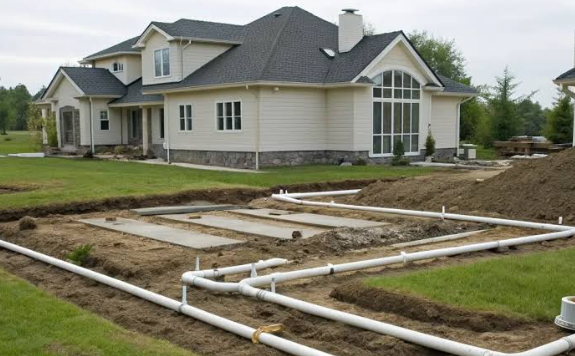
The footings are in on four acres of inherited pasture outside Lone Jack, the framing lumber is stacked under a tarp, and the soil evaluation just came back heavy clay. That one page stops the build. The conventional trench system the family penciled into their budget will not permit on that ground, which is why the search for septic tank installation lone jack mo usually starts in a panic instead of at the planning table. Here is the plain version, worth reading before the house plan goes final: the ground decides which septic system you are allowed to build, and the house only decides how big that system has to be.
Soil Gets Tested Before Anything Gets Drawn
Before anyone draws a trench, somebody digs a pit and reads the dirt. A soil evaluation looks at texture, at structure, at how far down you get before hitting a restrictive layer, and at the gray mottling that says groundwater parks here every spring. Those readings turn into a loading rate, which is nothing more exotic than the gallons a square foot of that soil will accept in a day. Sandy loam gives you a generous number. Lone Jack clay subsoil gives you a stingy one, and every decision downstream is built on top of it. Who is allowed to perform that evaluation, and what it has to document, is set by state and county rules that vary from one county line to the next, so call the county health department before you hire anybody.
Think of the soil as a one lane off ramp on a busy highway. The tank is the parking lot where cars wait their turn, and the drainfield is the ramp itself. You can pour a bigger lot all day long, but traffic still leaves at whatever rate that ramp allows. Clay is a narrow ramp on a hill, and no amount of concrete upstream changes what it will pass.
See also: How to Choose the Right Personal Injury Lawyer for Your Case
Clay Changes Which Designs Can Be Permitted
A conventional gravity trench system assumes the soil under it will take effluent at a reasonable clip. When it will not, the design goes shallower and slower rather than deeper. Low pressure pipe laterals sit up in the better topsoil and dose the field in small timed shots instead of dumping. Drip dispersion spreads the same daily volume over a much wider footprint. An aerobic treatment unit ahead of the field cleans the effluent enough that the soil has less work to do. Sometimes the answer is imported sand and a raised bed, because the ground you have simply cannot be improved in place. All of those cost more than trenches, and all of them are cheaper than a system that will not pass.
Say a conventional gravity system on friendly ground pencils out around $9,000 for that four bedroom plan. On clay, an illustrative budget for the pressure dosed alternative runs closer to $18,000 once you add the pump tank, the controls, the added field area and the engineering. Trade labor is not helping the math either. Home Renovation 4U reported in August 2026 that electricians are charging $60 to $145 an hour, up 6 to 8 percent from 2025 on labor shortages, and the excavation and plumbing trades are drawing from that same thin bench of licensed people.
Household Size Sizes The Field Not The Tank
Design flow gets figured from bedrooms, not from the people currently sleeping in them. A four bedroom plan is rated as a four bedroom load whether a retired couple moves in or a family of six does, because the house will outlive both. The rule our designs run on is roughly 120 gallons a day per bedroom, so that plan is sized for about 480 gallons a day and the field is laid out to absorb it on the worst soil day of the year, not the best. The bedroom count on the plan sets the field size, not the number of people moving in. The tank itself barely moves between a three and a four bedroom house. The field is what grows, and on clay it grows a lot.
Access And Slope Decide The Install Week
Three to seven days is the honest window for an install like this, and where a job lands inside it has almost nothing to do with the system on paper. Can a mini excavator and a dump truck reach the field area without crossing the new driveway apron? Is there a well, and where does its required separation distance land? Does the slope run toward the field or away from it? Job after job, the thing that adds days is not the digging. It is a gate too narrow for the machine, a wet week that turns clay into something you should not be driving on, or an inspection slot that falls on a Friday afternoon. Call it four days for a straightforward four bedroom system on that pasture. Honestly, closer to six once you count the rain day and the inspection wait, and I would rather tell you six now than four twice.
On inherited ground there is often an old tank somewhere out past the barn, and that is the part of the week that can actually hurt somebody. Nobody enters a septic tank. Nobody leans in for a look and nobody reaches in after a dropped tool, because OSHA’s hydrogen sulfide hazard page puts collapse at 1 to 2 breaths and death within minutes once concentrations reach 700 to 1,000 ppm. If a lid is missing or cracked, cover it and secure it right then, before anyone walks away. If a person goes down in or near an open tank, do not climb in after them. Get clear, call 911, and let the crew with air packs handle the retrieval.
A Bad Design Fails Long After Inspection
The cruel part of a badly matched system is the delay. It passes inspection, it works beautifully for two or three years while the soil interface is still open, and then one wet March the yard develops a soft strip that smells like a sewer and never dries out. By then the drywall is up and the landscaping is in. What usually turns up when we open one of these is either a conventional field on soil that never should have had one, or a good design that got compacted during construction because somebody staged materials and drove a loaded truck across the field area. Rope off the field before the house goes up. That flagging tape costs nothing and it protects the most expensive dirt on the property.
Design For The Ground You Actually Have
Heavy clay is not a verdict on the build. It is a constraint, and constraints are workable as long as you learn about them before the foundation money is spent rather than after. Get the soil evaluated first, size the system to the plan the family is actually building, walk the access route with whoever is bringing the machine, and budget for the design the ground allows instead of the one the neighbor got on sandy bottomland. A septic tank installation Lone Jack MO families never think about again starts in a soil pit, not on a price sheet. The soil pit does not negotiate, and every dollar you spend arguing with it comes back as a wet yard in a decade.