By Drake Miller – Senior Content Manager & Academic Consultant | Higher Education Strategy Specialist
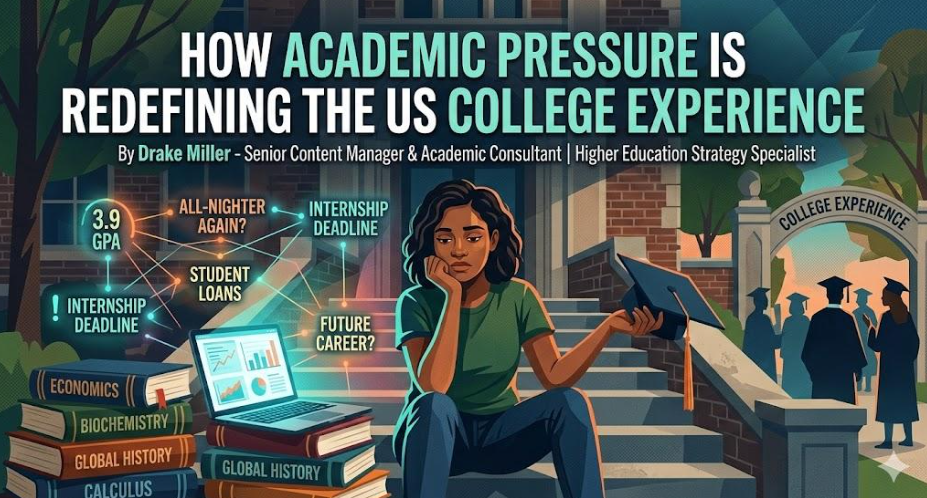
For decades, the American “college years” were romanticized as a period of self-discovery and social exploration. However, walk through any university library at 2:00 AM today, and you won’t find students reflecting on philosophy; you’ll find a generation in the grips of a mental health crisis.
As a Senior Content Manager with over a decade of experience in the educational sector, I have observed a fundamental shift in how students navigate their academic careers. In the United States, academic pressure has transitioned from a “rite of passage” to a primary driver of psychological distress. Recent 2025-2026 data suggests that nearly 87% of US college students cite education as their primary source of stress. As the stakes for post-graduate success rise, so does the weight on students’ shoulders.
The Modern Landscape: A “Perfect Storm” of 2026 Stressors
In a hyper-competitive global economy, American students are facing a “perfect storm” of stressors. It isn’t just about difficult exams anymore; it is the cumulative weight of structural shifts in the educational sector:
- Grade Inflation and “The Perfectionist Trap”: With more students applying for limited slots in Ivy League and top-tier graduate programs, a 4.0 GPA is no longer an achievement—it’s a baseline. The “fear of a B” has created a culture where one bad grade feels like a career-ending catastrophe.
- The AI-Driven Curriculum Shift: As we move through 2026, the integration of Generative AI in the classroom has actually increased pressure. Professors now expect higher-level critical thinking and “Information Gain.” To meet these standards, students must master the nuances of a professional essay format to demonstrate structured, high-level synthesis early in their careers.
- The Rise of High-Stakes Standardized Testing: Even after entering college, professional certifications (MCAT, LSAT, GRE) loom large, forcing students to begin “pre-studying” years in advance.
- The Financial Burden: With the average federal student loan balance hovering around $38,000, the pressure to perform isn’t just academic—it’s financial. Failing a class isn’t just a blow to the ego; it’s a wasted investment of thousands of dollars.
How Pressure Manifests: The Psychological Impact
The impact of this relentless drive for excellence is measurable. According to the 2024-2025 Healthy Minds Study, while there is a slight decrease in overall stigma, the severity of symptoms remains alarming.
1. The Burnout Cycle and Cognitive Load
Burnout is more than just being tired. For many US students, it manifests as cognitive overload. When the brain is in a constant state of “fight or flight” due to deadlines, it loses the ability to process new information effectively. This leads to a paradoxical dip in performance, which in turn causes more anxiety—a vicious cycle that leads many to consider dropping out.
2. Anxiety and Depression
Recent clinical screenings (PHQ-9) show that roughly 38% of US college students screen positive for moderate to severe depression. The “pressure to be exceptional” creates a sense of isolation. Students often feel that if they aren’t thriving, they are failing, leading to persistent feelings of hopelessness.
3. Physical Health Deterioration
The body keeps the score. Academic stress is frequently linked to:
- Chronic Sleep Deprivation: The “all-nighter” culture disrupts circadian rhythms, impairing memory consolidation and immune function.
- Substance Reliance: There is a growing trend of students using “study drugs” (unprescribed stimulants) or excessive caffeine to keep up with the workload, which often leads to long-term heart and nervous system issues.
The Search for Support: Why Students Turn to Professional Help
As curriculum rigor increases, students are realizing that “going it alone” is no longer sustainable. Many are seeking external resources to bridge the gap between their current skills and the high expectations of their professors.
This is where academic assistance platforms become vital. Integrating expert academic guidance—such as the comprehensive essay help provided by MyAssignmentHelp — can serve as a protective factor against cognitive overload. When the workload becomes unmanageable, these services act as a “safety valve,” allowing students to regain their footing, understand complex concepts through expert tutoring, and prevent the sheer volume of assignments from overwhelming their mental well-being. This proactive approach allows students to focus on mastery rather than just survival.
Coping Mechanisms: Moving from Survival to Success
While systemic changes in the American education system are needed, students can take immediate steps to mitigate the effects of academic pressure.
| Strategy | Implementation | Academic Benefit |
| Time Blocking | Assign tasks to specific hours | Prevents “infinite” workdays and decision fatigue. |
| The Big Three | Sleep (7-9h), Nutrition, Movement | Lowers cortisol and improves memory retention. |
| Active Recovery | 15-minute tech-free walks | Resets the prefrontal cortex for better focus. |
1. Redefining Time Management
Traditional “to-do lists” often add to the stress. Instead, experts recommend Time Blocking. By assigning specific tasks to specific hours of the day, students can create “containers” for their work, allowing them to truly disconnect once the block is over.
2. Embracing “Productive Failure”
High school and college students need to hear that a grade does not define their intrinsic value. Shifting the mindset from performance-based (I must get an A) to mastery-based (I want to understand this concept) can significantly lower cortisol levels and actually improve long-term retention.
The Role of Institutions and Educators
Universities in the USA are starting to take note. From “Wellness Days” to 24/7 telehealth counseling, the infrastructure for support is expanding. However, the most effective change comes from the classroom. Professors who offer “grace periods” or flexible deadlines report higher levels of student engagement and lower rates of academic dishonesty. In 2026, the focus must shift from “rigorous exclusion” to “rigorous support.”
Frequently Asked Questions
Q.1 How do I know if I’m experiencing “normal stress” or clinical burnout?
Stress is usually tied to a specific event (like a final exam) and dissipates afterward. Burnout is a chronic state of emotional exhaustion, detachment, and a feeling of reduced accomplishment that persists even after the deadline has passed.
Q.2 Is using academic support services considered ethical in 2026?
Yes, when used as a learning tool. Ethical platforms focus on tutoring and guided learning. Using these services to better understand a difficult prompt or to structure a complex research paper is a form of proactive academic resource management, similar to visiting a campus writing center.
Q.3 What is the fastest way to lower anxiety during a “high-stakes” exam?
Use the 4-7-8 breathing technique. Inhale for 4 seconds, hold for 7, and exhale for 8. This physically signals your nervous system to exit “fight or flight” mode.
Conclusion
Academic pressure is a defining characteristic of the 21st-century American student experience, but it doesn’t have to be a destructive one. By acknowledging the reality of burnout, utilizing professional academic support services when necessary, and prioritizing mental health over a perfect transcript, students can navigate the challenges of higher education without losing themselves in the process.
The goal of college should be to build a future, not to break a person. As we move through 2026, it is time for students, parents, and educators to prioritize the “whole student” over the “whole GPA.”
About the Author: Drake Miller
Drake Miller is a senior content manager and academic consultant at Myassignmenthelp.com with over a decade of experience in education and higher education strategy. Drake specializes in optimizing digital content for student success and has been a leading voice in the integration of ethical AI tools within the 2026 academic landscape.