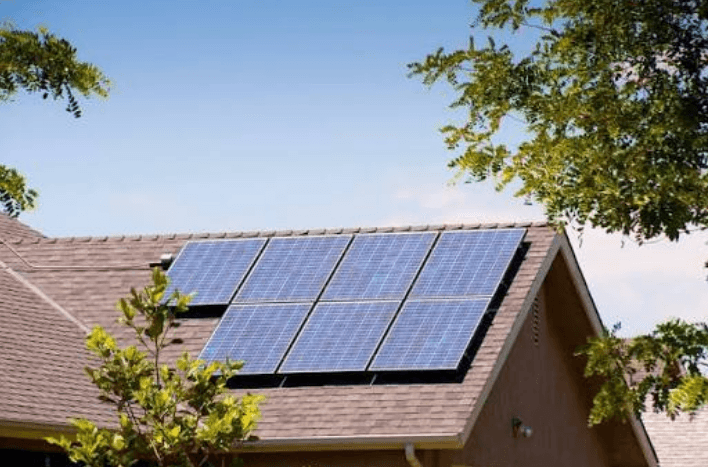
The quote lands by email on a Tuesday afternoon: two pages, a tidy rendering of the roof traced off satellite imagery, and one confident number at the bottom promising 9,400 kilowatt-hours a year. Nobody visited. The seller works three states away and has never stood in the driveway of this wooded half-acre south of Olympia, where eighty-foot second-growth firs run the whole length of the south property line. That detail matters more than the panel brand, the inverter warranty, or the financing term stapled to the back page. A homeowner comparing bids for solar panels olympia wa is usually comparing two unlike things, a design drawn from a map against a design drawn from a roof somebody actually climbed. The argument of this piece is narrow and stubborn: an on-site shade and orientation assessment is what makes a production estimate checkable, and a number nobody can check is not really a proposal.
A Mapped Roof Cannot See the Tree Line
Remote design software is genuinely good at a few things. It reads roof pitch and compass orientation off aerial imagery, measures usable plane area to within a foot or so, and lays out a panel array faster than anyone working with a tape measure and a notepad. What it reads badly is anything vertical. A sixty-year-old fir arrives in the data as a green smudge whose height gets inferred from the shadow it happened to cast at whatever hour the plane flew over, and those flights usually happen near midday in summer, when shadows are shortest and every site looks flattering. Installers call the missing piece solar access, meaning the share of the year’s available sunlight that actually reaches the panels once obstructions are subtracted. What we see most often on wooded lots is a proposal claiming solar access in the mid-nineties for a roof that measures in the seventies once somebody stands on it. No one lied to anybody. The imagery simply could not see what a person in the side yard sees in four seconds.
Shade Losses Concentrate in the Darkest Months
Shade does not spread itself evenly across the calendar, which is the part remote quotes flatten into a single average. Around this latitude the December sun tops out near nineteen degrees above the horizon, so a mature fir throws a shadow roughly three times its own height at noon. Eighty feet of tree becomes something close to 240 feet of shadow, considerably farther than the distance from that south property line to the ridge of the house. The same tree in late June casts maybe thirty feet and has cleared the roof entirely by nine in the morning. Shade is the reason two bids for solar panels Olympia WA properties receive can differ by thousands of kilowatt-hours on identical square footage.
The months that pattern bites hardest are the months the power bill is highest. Heat pumps work their longest hours from November into February, and that is precisely the stretch when a shaded array contributes least back to the meter. Trees win that argument eventually, so the honest move is to design around them rather than around a summer photograph.
Questions a Site Visit Answers That Software Cannot
A real assessment is an hour on the property with a shade measurement tool held at each corner of every roof plane, sweeping the sky to record where the horizon is blocked and at what times of year. The technician notes the neighbor’s cedar that will be ten feet taller in five seasons, the chimney nobody drew, the vent stack sitting exactly where a panel wanted to go. Ask what the estimate assumes about all three. The same guessing habit shows up in heat pump sizing done over the phone, where an approximate square footage quietly becomes an approximate system and the homeowner learns about it in January, though that is a subject for another article. Back on the roof: stay off it yourself. A shade reading is not worth a fall from a wet composition slope.
Can an Installer Just Check Shade From Satellite Images?
Partly, and that is the trouble with it. Aerial data gives a reasonable read on roof geometry and a rough guess at obstruction height, but it cannot tell a dying alder from a healthy fir or account for growth over the twenty-five years the system is supposed to run. Treat a map-only estimate as a starting conversation rather than a production commitment.
Do I Have to Remove Trees to Go Solar?
Often no. Selective limbing on the south side, or shifting the array to a less obvious roof plane, recovers a surprising amount of winter production without touching the trunk. Removal and topping rules vary by city and county in Washington, so check with your local permitting office before anybody prices a chainsaw into the project.
See also: Common Trademark Mistakes Businesses Make and How Attorneys Fix Them
How Long Should an On Site Solar Assessment Take?
Plan on sixty to ninety minutes for a straightforward house. That covers the roof planes, the electrical panel and its available breaker space, the meter location, and a walk of the property line where the shading originates. Anything finished in fifteen minutes was a sales call wearing a tool belt.
An On Site Assessment Comes Before Any Contract
The sequence is the whole point. Solar resource mapping from the National Renewable Energy Laboratory, current as of August 2026, shows winter shading cutting output by as much as 38% against summer production at the same location, and that swing is exactly the gap a site visit exists to measure rather than assume. Ask any installer to show the measured shade readings behind their monthly production table, plane by plane, before signing anything. A contractor who has walked the roof can produce those numbers on the spot, and a contractor who has not will change the subject to financing. That difference is worth more than any discount on the first page of the quote.