
Digital marketing in Australia looks completely different now compared to three years ago, with higher competition, changing algorithms, and new privacy rules. That’s why businesses still running old strategies are watching competitors pull ahead while they scramble to figure out what changed.
However, Australian Business Magazine has been tracking these shifts across industries, and the patterns are obvious. Social media, local SEO, paid ads, and AI automation now form the backbone of any serious marketing plan. So, companies ignoring these trends are losing market share to businesses building smarter systems.
This guide covers what’s actually driving growth for Australian businesses right now. You’ll also learn which platforms deserve your focus, how to rank locally without burning cash, and where AI fits into your marketing plan.
If you’re running your own business and want practical advice on what’s working today, keep reading.
Social Media Marketing: Where Australian Brands Actually Connect
Australian businesses are shifting budget from traditional advertising to social platforms because customers spend 2-3 hours daily scrolling and engaging there (and yes, your competitors are doing the same thing).

Social media marketing isn’t optional anymore. Instead, it’s where potential customers discover brands, compare services, and decide who gets their business.
Many businesses waste mostof their social media budget on platforms their target audience never uses. So they should focus on the following areas:
Choosing Platforms That Match Your Audience
Research where your customers actually spend time online instead of spreading yourself thin across every social media platform available. For example, B2C brands see stronger results on Instagram and Facebook, while B2B companies generate more leads through LinkedIn activity.
In fact, a Melbourne retailer we worked with cut their social spending by 40% just by dropping platforms their target market wasn’t using.
Platform demographics shift every year, too. That’s why you should review your analytics quarterly to confirm you’re investing effort where it pays off.
Frankly, most businesses guess which channels to use instead of checking the research. Don’t be one of them.
Content That Gets Shares, Not Just Scrolls
Behind-the-scenes content and real employee stories humanise your brand in ways polished advertisements can’t match. People often save and share educational posts, solving specific problems rather than promotional content focused only on selling. This approach works because helpful content attracts new customers without feeling like advertising.
Local references, Australian humour, and culturally relevant topics also perform better than generic international marketing templates. After working with Melbourne-based retailers for the past few years, we’ve noticed Instagram Stories showing real store operations drive more foot traffic than any other format.
Beyond these, video content consistently outperforms static posts across platforms. As a result, reels and short-form videos generate the highest engagement rates, which helps your business grow its reach without paid promotion.
Search Engine Optimisation for Local Visibility
Local SEO determines whether your business appears when someone searches “near me” or types your suburb into Google. Meanwhile, search engine optimisation puts your services in front of customers actively looking for what you sell. Once you miss this, competitors ranking above you will take the revenue.
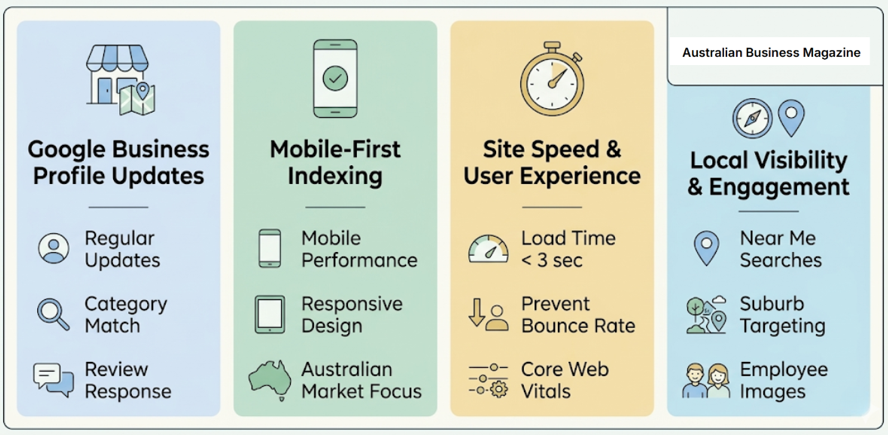
Now, let’s see what actually moves the needle for local search results:
Google Business Profile Updates That Are Significant
Generally, regular posts, Q&A responses, and photo uploads signal active management. Google rewards this with better placement in map results. However, categories and service descriptions must match search intent exactly, using the same language customers type into search bars (this is the bit most businesses get wrong).
Furthermore, response time to reviews affects your profile’s perceived reliability and influences Google’s ranking algorithm for local searches. Adding employee images and updating your Google Business Profile details quarterly also keeps listings fresh. The industry standard now even includes location-specific website pages targeting individual suburbs across Australia.
Mobile-First Indexing and Speed
Google now ranks sites based on mobile performance first, which is why desktop-only optimisation no longer protects your search engine visibility in the Australian market.
Page load times under three seconds usually prevent bounce rates from tanking rankings, especially for users on mobile data connections. It means if your website takes five seconds to load on mobile, you’ve already lost the visitor.
Besides, core Web Vitals measure real user experience, penalising sites with layout shifts or delayed visual loading. Speed’s only half the equation here, though. This way, mobile design affects how customers engage with your services across different network conditions.
See also: 4 Helpful Tips to Get Your Business Out of Debt
Paid Advertising Without Burning Your Budget
With paid advertising, you can control exactly how much you can spend and pause campaigns the moment they stop delivering results (spoiler: it’s not as expensive as you think). In fact, online advertising gets your business in front of potential customers faster than any other digital marketing channel.
Here’s what separates successful campaigns from costly mistakes:
Retargeting Campaigns That Actually Convert
Website visitors who didn’t purchase the first time convert at higher rates when retargeted with specific product reminders. This strategy allows you to reach people who have already shown interest in your services.
Sometimes, abandoned cart ads with time-sensitive offers create urgency without devaluing your products. Plus, frequency caps prevent ad fatigue by stopping your promotion from annoying potential customers into blocking your brand.
Quick tip: Track cost-per-acquisition in your digital marketing campaigns to measure actual sales rather than just analysing impressions or clicks.
Setting Realistic Ad Spend Expectations
According to our investigation, most businesses need at least $500-$1000 monthly to gather enough data for meaningful campaign optimisation. Although the financial situation varies by industry, this investment gives platforms enough information to develop better targeting.
Honestly, the first week of ads doesn’t deliver instant results. Allow 60-90 days for proper testing. Algorithms need time to learn audience behaviour and improve performance. Over time, knowledge from these tests helps you understand your target market and adjust your marketing plan accordingly.
How Artificial Intelligence Fits Into Your Marketing Plan
AI automates repetitive marketing tasks, analyses customer behaviour patterns, and predicts which leads will convert, so you spend less time guessing.
That’s how artificial intelligence is changing how businesses in Australia handle digital marketing campaigns, from email marketing to customer support. The innovation here saves employees hours of manual work.
Let’s have a look at what more AI can actually do for your business plan right now:
AI Tools for Email Marketing Automation
AI tools send time optimisation analyses when individual subscribers typically open emails, then schedule delivery for peak engagement windows. Besides, subject line testing runs automatically across audience segments to identify which messaging approaches drive the highest open rates.
On top of that, behavioural triggers send personalised emails based on specific actions, like browsing products or abandoning forms. Digital tools handle this automatically, so your marketing plan stays active even when employees aren’t working.
Predictive Analytics in Your Business Plan
Customer prediction models identify accounts likely to leave and allow proactive retention campaigns that protect revenue. Sales forecasting also uses historical patterns and current pipeline data to project revenue more accurately than manual estimates (which sounds fancy but really just means ‘better guessing’).
Inventory planning powered by AI typically reduces overstock and stockouts by predicting demand fluctuations across the Australian market. This innovation helps suppliers and companies manage costs while maintaining service levels.
Bottom line: The knowledge AI systems develop about your customers improves business processes over time and shows which promotion strategies work best for your target market.
Ready to Update Your Strategy?
Digital marketing in Australia keeps evolving, and businesses waiting for trends to stabilise are falling behind competitors who adapt quickly. The market rewards companies even willing to test new channels, measure performance, and adjust their plan based on real data rather than guesswork.
Focus on what delivers growth for your business right now. Social media platforms, search engine visibility, paid ads, and AI tools all work together when you develop a cohesive marketing plan. Remember, success comes from consistent effort instead of one-off campaigns.
Australian Business Magazine provides advice and knowledge to help your business grow. Explore more resources on digital marketing strategies, innovation in the Australian market, and practical tips for building a successful business at our site.